
RIGIS Routing + Mileage: A New, Intelligent
Routing
Solution Built on a One-of-a-Kind Network
After a multi-year collaboration with
the AAR GIS Committee to
develop
schemas that pieced data together…
RAILINC ROLLED OUT A ONE-OF-A-KIND ROUTING AND MILEAGE NETWORK SOLUTION
in the Rail Industry GIS (RIGIS) Portal.
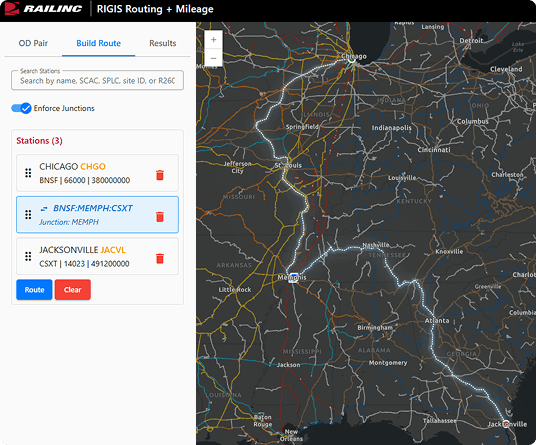
The network spans the entirety of North America and allows shippers, car owners, railroads, and others to visualize and analyze routes and mileage.


This new tool enables mileage synchronization and consistency across the industry: instead of a user having to rely on third-party applications that may have outdated or inaccurate data, the RIGIS routing and mileage module is built by authoritative data from railroads and is updated quarterly.
When a user searches an origin/destination pair, the application displays viable routes, carriers involved, and breaks down miles traveled in each state. Users also have the option to input preferred carriers to increase the accuracy of the route.
Users can also build their own route by selecting multiple routing locations, with the option to create a more intelligent route through the inclusion of required junctions at interchange locations.
The new API is robust, handling more than
1,000
origin-destination pair requests per second.
Contributing to Ongoing Industry Safety
Efforts by Rethinking Alerts
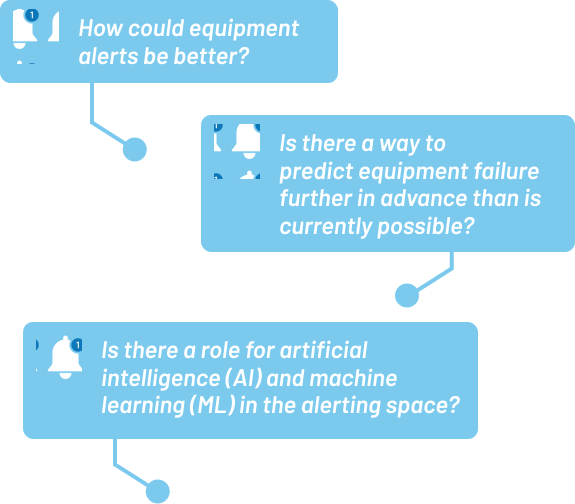
To explore these questions, Railinc worked with industry stakeholders to conduct a study to explore the utilization of Intelligence / Machine Learning (AI/ML) models for alerting purposes.
Alerts are currently sent to customers when equipment has been identified by detectors as requiring inspection and potential repair, based on a series of rules created by the rail industry. By using an ML model, which is well-equipped to solve rule-based problems, to study equipment trends—movement data, component age, condition, equipment type, and more—and alerting rules, could the model alert a wheel bearing failure sooner than current industry reporting?
Utilizing Railinc’s vast database of rail equipment information, the team trained a bearing failure detector model on documented instances of bearing failure, from data that was derived from industry hot bearing detector (HBD) sensors. When put to the test, the model correctly identified nearly half of all simulated failures earlier than standard reporting, which would give railroads a chance to pull their equipment for repair sooner.
While the initial focus was on wheel bearings and gathering information from HBDs, Railinc can use the knowledge gained from this project to train models that target other equipment issues in the future.
Machine Vision Provides Clearer Insight
into Equipment Defect Reporting
In 2025, Railinc worked with the industry to organize 55 defect categories into 22 new alert types for onboarding into the Equipment Health Management System (EHMS).
Nine of these new Machine Vision alerts were prioritized for distribution via EHMS when reported by railroads after a successful detection is captured at track speed via Machine Vision detection portals.
Machine Vision detectors utilize high resolution cameras and advanced sensors to identify defects on a moving train. The detectors use AI algorithms to analyze image data and detect defects present on the equipment that might go unnoticed when the equipment is stationary.
Railinc also introduced a new EHMS notification format version to accommodate these new alerts. This new format ensures that industry subscribers receive detailed instructions of the defect captured.
Supporting the Finalization of the CPKC Merger
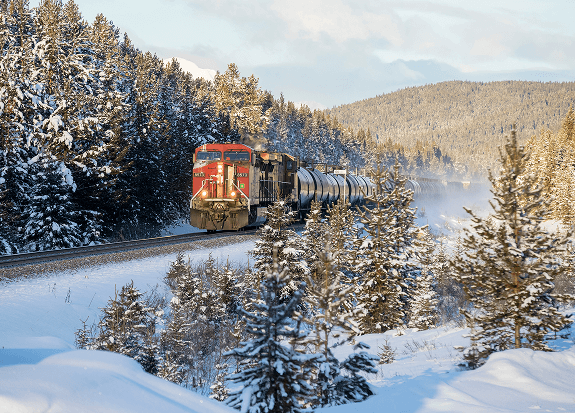
As separate entities, both Canadian Pacific (CPRS) and Kansas City Southern (KCS) were tied into 27 Railinc applications, including financial reconciliation, equipment management, and safety apps. Upon the two railroads merging, Railinc had to update more than 21,000 critical files to reflect the CPKC combination.
The entire process spanned several years, required close cooperation with CPKC team members and extensive data verification, and culminated in the official system cutover on May 3, 2025. On the day of the cutover, team members kept an open communication channel with CPKC to ensure transparency and fast resolution time in the event of any hiccups.
Business and development teams made significant updates to several Railinc applications and services to help ease the transition, including: developing code to run inventory reports on-demand; improving AskRail® to support the family relationship under CPKC; and updating Umler pools. Post-merger, Railinc teams ran reports for more than a dozen applications to confirm data and permissions had been successfully updated.
Updated Files Included:
 20,617
Routes
 265
265
Junctions
 872
872